The French Cancan: the story of the Moulin Rouge’s dance
The French Cancan, far more than just a dance, emerged in the 19th century as a symbol of freedom and female emancipation. With its high kicks, swirling petticoats and overflowing energy, this reimagined quadrille found its stage in Parisian venues, particularly at the Moulin Rouge, a landmark of cabaret culture. How did this bold dance come to be? And how did it become one of the defining symbols of French performance art? A closer look at the history of the French Cancan.
From popular dance halls to Moulin Rouge dinner shows: what are the origins of the French Cancan?
The story of the French Cancan dance dates back to the 1820s. At that time, the quadrille was the dance performed at public balls in the capital. To the beat of original compositions taken from operas and ballets, couples indulged in this five-figure dance.
Quickly, men took it over and began dancing the quadrille alone, performing a few minutes of improvised, chaotic figures as a way to let off steam. The name of this revisited dance? The chahut, meaning uproar or commotion.
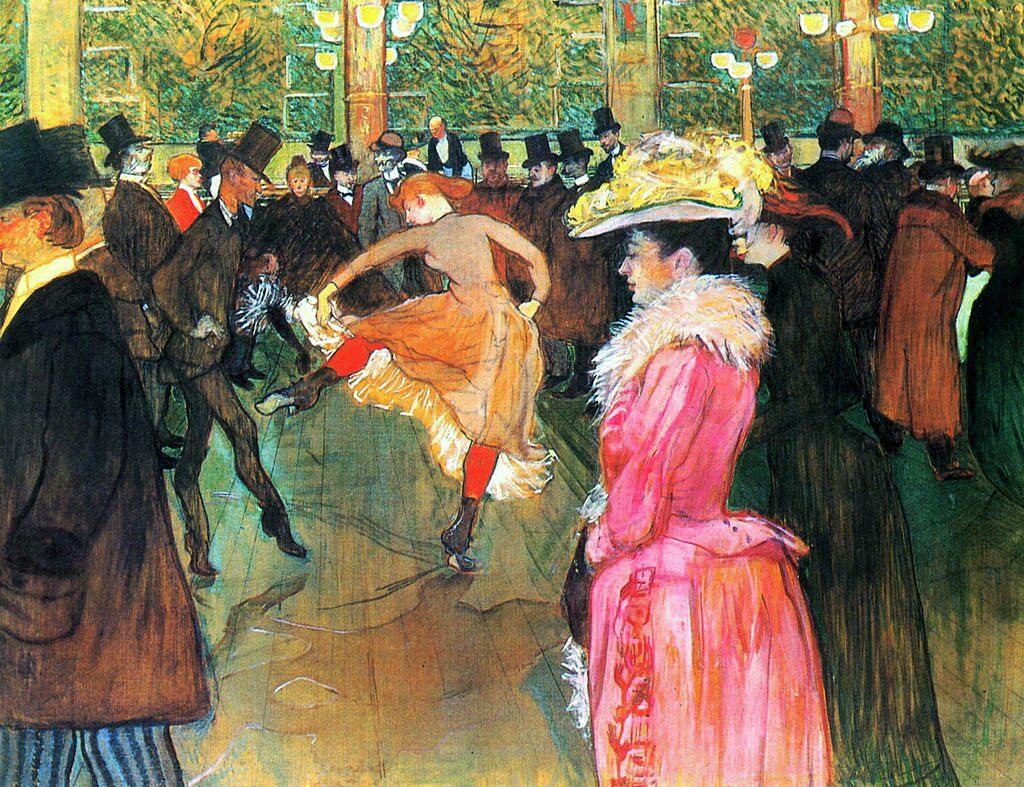
Paris in 1850 was buzzing with excitement. Theatres, comedy shows and public balls were booming. Some time after the emergence of the chahut, daring Parisian women decided to take up the frenzied dance as an outlet. At these events, one dancer made the news. Céleste Mogador, star of the Bal Mabille, set Parisian hearts aflutter with her unpretentious quadrille. She was an instant hit!
10 years later, Charles Morton, the inventor of modern music-hall, presented this surprising dance on the Oxford stage. He renamed it the French Cancan because it came from France and caused a stir. Soon after it appeared in Oxford, the socially aware dance was banned for being too daring.
In the city of Paris, however, the popularity of the quadrille now known as the French Cancan was growing. The reason? The incredible cancan dancers of the Moulin Rouge. In 1889, these linen maids of Montmartre Hill took the stage to the astonished gaze of the audience. For them, the cancan was a way of challenging the established order. Some of them became iconic figures. The French Cancan shows in the lavish Moulin Rouge cabaret became more and more popular.
So popular that in 1955, Jean Renoir decided to make a film based on those shows. The result was the film French Cancan, with Jean Gabin playing the role of Danglard.
And to this day, the Moulin Rouge and its dancers continue to impress visitors at dinner shows, where they can admire the Cancan performers in their fabulous feather- and rhinestone-covered costumes.

The French Cancan, quite an art.
A lively rhythm, swirling petticoats, and striking acrobatics, the Moulin Rouge dancers have mastered the art of the cancan. A true phenomenon, it has not always been what it is today. It was La Goulue, a famous dancer, who ultimately established its rules. They were then passed down orally until Nini Pattes en l’Air decided to found a school dedicated to this explosive quadrille.
The French Cancan is an eight-minute performance in front of an audience, during which the dancers, typically around 1.70 metres tall, lead the routine to the music of Offenbach. This art form requires balance, flexibility, acrobatic skill, and a strong sense of rhythm. Dancers must be able to perform the splits and execute impressive French Cancan figures such as the “port d’armes,” “the cathedral,” and the “military salute.”
But what would the French Cancan be without its iconic costume? Each dancer’s dress is entirely created by the Moulin Rouge’s ateliers. It involves 200 metres of frills per petticoat and 32 metres per pair of bloomers. Rhinestones, bows, and ribbons are assembled by hand. With the intensity of this high-energy dance, the costumes certainly have to keep up.
Incredible records!
Let the celebrations begin! The Moulin Rouge invites you to discover its Féerie Revue show and enjoy a thrilling evening as a family with your children, as a couple or with friends. Feel the buzz from the artists and witness extraordinary performances that will blow your mind.
Incredibly, since 2010, the Moulin Rouge troupe has held seven world records in the Guinness Book of Records. And yes, the bar is very high at the Moulin Rouge. Among these achievements, the greatest number of French Cancan rond de jambe kicks. The dancers did 29 in 30 seconds at the foot of the Moulin Rouge. Impressive, no?
And that’s not all — cancan dancers have also achieved the most high kicks and spinning splits in 30 seconds: 720 high kicks and 62 spinning splits. Ready to take on the challenge?
The Moulin Rouge troupe can’t wait to present its Féerie Revue show for you. Discover the combination of dance and parisian atmosphere prepare to experience an exceptional show in this iconic cabaret.
What makes the French Cancan so distinctive?
The French Cancan stands out for its spectacular moves, blending contortions, high kicks and acrobatics worthy of a true cabaret act. Everything is performed at a breakneck pace, driven by a contagious energy. The dance is also instantly recognisable thanks to its signature “French Cancan” shout and its iconic figures, which have become the hallmark of a style that is both daring and unmistakably revolutionary — in spirit as much as in form.
French Cancan: what about the music?
It’s impossible to talk about the French Cancan without mentioning the “Galop infernal” from Orpheus in the Underworld, composed by Jacques Offenbach. This piece sets the tone: fast, lively, almost frenetic. It’s to this rhythm that French Cancan dancers perform their sequences, making the music of the French Cancan an essential part of the spectacle.
Other news
How to make the most of Paris’s Fête de la Musique ?
Step into the vibrant effervescence of the Belle Époque
When Moulin Rouge® and the Monnaie de Paris Combine their expertise
How to visit Paris on foot ? Our best walking itineraries
What to do in Paris in autumn?