


WHAT IS THE QUADRILLE AND HOW DO YOU DANCE IT?
At the heart of Parisian balls, the quadrille stands out as a dance full of grace and tradition, where every step tells a story. Descended from 18th-century country dances, it invites participants to rediscover a subtle art of elegance and social connection. Whether you are a beginner dancer or a history enthusiast, immerse yourself in this fascinating world where precision and conviviality come together to bring a unique ballet to life.
What is the quadrille?
It takes only a few notes for the rhythm to kick in. Four couples form a square, facing one another. Eyes meet, feet adjust. Then the music sets the movement in motion: a sequence of figures, precise steps, and partner exchanges that create a true ballet for eight. Every step is codified, every position designed to correspond with the others. This play of back-and-forth, angles, and lines is what we call the quadrille.
This ballroom dance has its roots in the French contredanse of the 18th century. At the time, choreographies were repeated like a refrain. Soon, however, a desire for innovation emerged: sequences were alternated, styles varied, and new passages introduced with each entry. The quadrille was born from this evolution and gradually established itself in Parisian balls, salons, and dance schools.
Its structure stabilized in the early 19th century. Each quadrille begins with a musical introduction: eight measures to be listened to while standing, focused, before entering the dance. This is followed by five successive figures, each with its own identity, rhythm, and movements:
- Le pantalon
- L’été
- La poule
- La pastourelle (or la trénis)
- La finale (or saint-simonienne)
Some figures draw inspiration from popular dances such as the mazurka, waltz, or galop. Others rely on intricate steps, arm crossings, and face-to-face as well as back-to-back exchanges. The quadrille is not a dance to be performed alone: it is experienced together, in a delicate balance of precision and liveliness, rigor and enjoyment.
What is the origin of the quadrille?
The quadrille, an iconic dance of the 19th century, has its roots in the French contredanse of the 18th century. Originally, it was a sophisticated dance where gentlemen performed precise steps such as balancés, traversés, and intricate figures to shine at elegant balls.
Over time, this strictness faded. Around 1840, the quadrille lost some of its technical complexity. Dancers adopted simpler steps and sometimes merely walked, as noted by Cellarius in La Danse des salons.
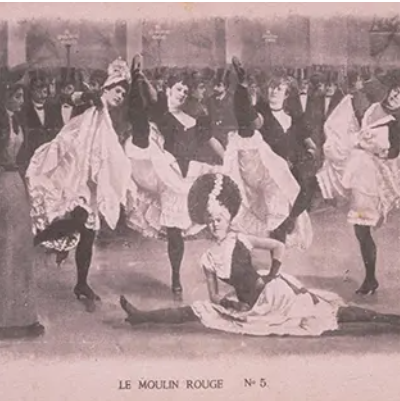
In public balls, the dance evolved even further. Figures were simplified, giving way to freer and almost unrestrained energy. This style would soon develop into the chahut and later the cancan, born in the student balls of the Latin Quarter and quickly embraced throughout Paris.
The quadrille was not limited to France. It traveled to Austria where it was danced as the Française, often set to music by Johann Strauss. In Vienna, a six-figure quadrille survives, reminiscent of the original form. It can also be found in Belgium, Denmark, and even New York, a testament to its lasting influence and varied adaptations.
Today, its figures even resonate in the Brazilian carnivals of Pernambuco, showcasing the dance’s remarkable ability to cross borders and centuries.
How to dance the quadrille?
The French salon quadrille is a dance full of charm, structured around five figures performed by two couples facing each other. Imagine yourself at the heart of an elegant ball, where every step tells a story.
First figure: Le Pantalon
The music begins gently with eight measures of introduction. Then the steps start: the famous English chain, where the couples exchange places gracefully, passing one in front of the other, shoulder to shoulder, in a fluid and harmonious movement.
Next comes the balancé, where the gentleman and lady greet each other softly before turning together hand in hand. Then the ladies’ chain follows, a delicate exchange marked by graceful half-turns, leading into the half promenade where each advances lightly to take the place of their partner.
Finally, a half English chain brings everyone back to their original position. The sequence repeats to close this first figure with refinement.
Second figure: L’Été
Here, the couples enter a livelier dance, alternating forward and backward steps called avant-deux and traversés. Exchanges between gentlemen and ladies set the rhythm, while glances meet in time with the movements. A graceful bow concludes the figure before the second couple repeats the same sequence in harmonious fashion.
Third figure: La Poule
The sequence continues with smooth traversés, followed by a balancé where gentleman and lady glide in perfect coordination, hand in hand. Then comes the half promenade, light and airy, followed by a repetition of the forward steps and half English chain. Couples exchange, turn, and find each other again, like a graceful ballet in which everyone knows their part.
Fourth figure: La Pastourelle
This figure invites playfulness and interaction. Couples perform an avant-deux followed by an avant-trois where gentlemen and ladies weave together, advancing and retreating in rhythm. The sequence concludes with a half-circle danced lightly, then a half English chain returning everyone to their place, ready to start again.
Fifth figure: The Finale
The dance reaches its peak with steps including avant-quatre, avant-deux, traversés, and balancés, punctuated by bows and hand-in-hand turns. This final figure can be repeated several times, extending the celebration and the joy of dancing together. In more intimate balls, it may be replaced by the Saint-Simonienne, a galloping, high-energy dance that ends the quadrille on a festive note. The quadrille always concludes in style, with a grand gallop or a farandole, where all dancers, united, celebrate the dance and the shared joy of movement.
What is the connection between the quadrille and the French Cancan?
The quadrille, the quintessential salon dance, paved the way for a living art form that evolved over the centuries. It is from this elegant framework that the French Cancan was born, embodying a new energy and a sense of freedom on Parisian dance floors.
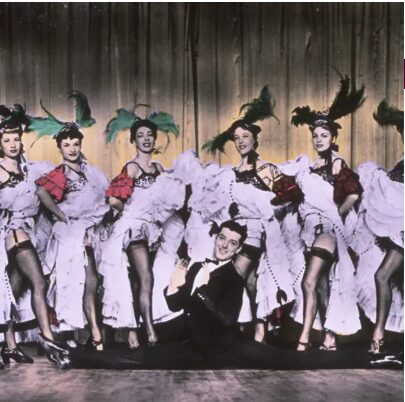
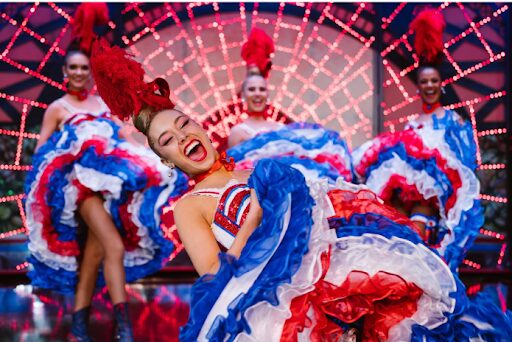
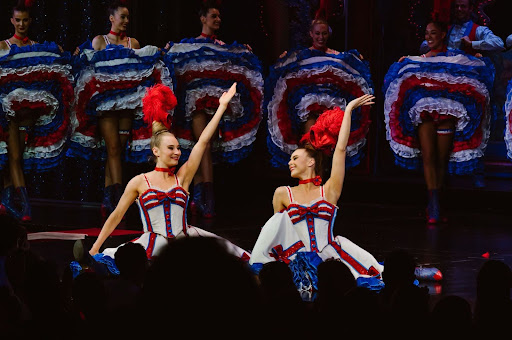
While the quadrille relies on codified figures, the Cancan drew its vitality from the spontaneity of popular balls, all the while maintaining a subtle link to its origins. This continuity can still be felt today on the stage of the Moulin Rouge show, where the revue Féerie celebrates this living heritage every evening. Between precision and audacity, these dances continue to converse, carried by the same momentum, that of a Paris which knows how to combine tradition and invention.
Other news
WHAT IS THE OFFICIAL STAGE COSTUME OF THE FRENCH CANCAN?
WHAT IS THE HISTORY OF FRENCH CANCAN DANCERS?
WHAT ARE THE SIGNATURE FIGURES OF THE FRENCH CANCAN?
Moulin Rouge! The Musical: Broadway’s Most Spectacular Night Out
THE BEST NEIGHBORHOODS IN PARIS TO EXPLORE: OUR SELECTION