


WHAT ARE THE SIGNATURE FIGURES OF THE FRENCH CANCAN?
The French Cancan, the iconic cabaret dance, captivates with its boundless energy and acrobatic moves. Far more than just a performance, it is a demanding art form that blends precise technique with artistic expression. Whether you want to simply admire its feats or try it yourself, learning the French Cancan requires discipline, flexibility, and commitment. In this article, discover the main moves that make up this unique repertoire and the keys to understanding both their technical and symbolic significance.
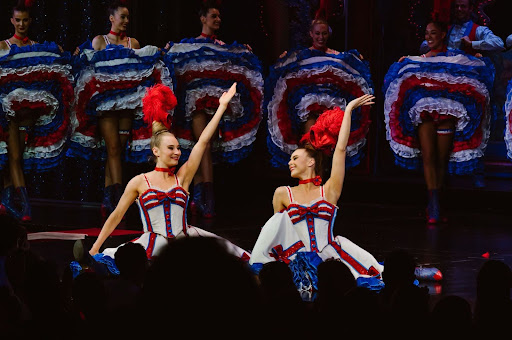
What are the most iconic French Cancan figures ?
The split
In the fast-paced sequence of French Cancan moves, the split delivers a striking, almost acrobatic visual pause. The move involves projecting one leg forward and the other backward until the hips are fully opened. It must be executed with breadth, stability, and precise control. The landing, in particular, requires great discipline: the impact must be absorbed without losing posture, so the dancer can immediately continue with the next step of the choreography.
On stage, French Cancan dancers perform in groups, which demands precise spatial awareness. When executing the split simultaneously, every position is measured to the millimeter. Feet must follow a clear line, arms accompany the motion to maintain balance, and above all, any visual misalignment must be avoided. One leg raised too high, one placement slightly off, and the unity of the line is broken.
Mastering this move takes hours of preparation. Joint work focuses on hip flexibility, pelvic alignment, and strengthening the deep muscles. But technique alone is not enough.
The leg lift (or battement)
The leg lift, also called battement, is a fundamental move of the French Cancan. It involves projecting the leg forward in a quick, extended, and controlled motion while maintaining strict alignment of the upper body. The battement originates from the hip with a sharp push, followed by an immediate return. This dynamic requires constant muscular engagement and perfect control of the movement.
The move truly comes to life when timed with the music of the French Cancan, particularly the frenzied gallops of Jacques Offenbach. Each leg lift becomes a direct response to the rhythmic accents, a visual punctuation on the strong beats. Synchronization with the music is crucial. A battement launched too early or slightly off disrupts the group’s unity and breaks the choreographic structure.
On stage, the visual effect relies on millimeter-perfect coordination. Dancers must not only perform the movement with precision but also integrate it into the collective space. Leg height, angle of attack, direction of gaze, everything is codified to create a clear and striking line. It is this discipline, combined with the tempo’s liveliness, that gives the battement its impact.
The charging step
The charging step is a dynamic move that gives real momentum to the French Cancan. It involves stepping forward while projecting one leg in front, leg extended and foot flexed, while pushing off with the other leg. At first glance, the movement may seem simple, but it requires precise placement and significant muscular engagement, particularly in the thighs, hips, and core.
Performed in sequence, this forward motion creates a pounding effect on the floor that intensifies the scene. The charging step is a move of projection: it is not simply walking or running, but occupying the space with energy while maintaining body alignment. The upper torso stays steady, the arms are held to prevent any loss of balance, and the gaze is always directed forward.
The corkscrew
The corkscrew is a typical French Cancan move, recognizable by its large alternating side kicks combined with a twisting motion of the upper body. It is performed standing, with fists firmly placed on the hips, holding the skirt on each side, and the legs projected one after the other in a sharp, controlled manner.
The right leg is kicked first to the right, extended and parallel to the floor, followed by the left leg to the left. The movement is performed sideways rather than forward, which requires good hip flexibility and strong stability on the supporting leg. With each leg extension, the torso twists slightly in the opposite direction, giving the move its name: the body spirals, creating a visual effect reminiscent of a corkscrew.
The leg-over-shoulder
The leg-over-shoulder is one of the most demanding French Cancan moves, both technically and physically. It involves placing the extended leg on the shoulder while maintaining a stable posture, then turning around with small hops backward.
To perform the move, the dancer first grabs her foot with both hands, one holding the heel and the other the tip. This double grip guides the leg onto the shoulder while keeping the knee fully extended. The leg must remain straight and aligned throughout the movement. The lift is executed with control, requiring sufficient hip opening and strong core engagement.
Once the leg is in position, the rotation begins. Small circular steps are taken backward, hopping on the supporting foot. The leg resting on the shoulder acts as a visual and structural anchor. The torso stays upright, the arms stabilize the leg, and the hops are carefully timed to maintain balance throughout the turn.
Foot in hand
Foot in hand is an iconic French Cancan move, both spectacular and technically demanding. It involves extending the leg into a front split, then grabbing the sole of the foot with the hand on the same side, arm fully extended. In this extreme balancing position, the dancer rotates on herself, hopping on the supporting leg.
This move highlights the flexibility of the raised leg, the stability of the center of gravity, and the ability to maintain a clear line throughout the movement. To avoid collapsing the torso or losing alignment, it is essential to keep the core engaged, shoulders relaxed, and the arm perfectly aligned with the leg. The hop is subtle yet strong, and the rotation must remain smooth, without any jerks.
The shrimp
The shrimp is a French Cancan move that combines balance, flexibility, and coordination in an asymmetrical and highly expressive gesture. To perform it, the dancer begins by holding her skirt with both hands, fists on her hips, as in many moves from the repertoire. But quickly, one arm is released to allow the leg to lift.
The leg is bent, knee raised to shoulder level. The arm on the same side then slides under the thigh, elbow bent, and grabs the leg just below the knee, holding everything in a compact shape. The other hand stays on the hip, keeping hold of the skirt. This posture creates a visually off-balance effect, yet remains highly structured, with the leg forming a sort of handle in front of the torso.
Once the position is held, the dancer performs small hops on the supporting leg while bending and extending the held leg. This movement produces a highly recognizable rhythmic vibration on stage, emphasized by the tension in the arm and the regular oscillation of the leg.
French Cancan figures : what do they mean?
An expression of freedom and provocation
In its early days, the French Cancan established itself as a dance of rebellion. With high kicks, lifted skirts — iconic elements of the French Cancan costume — and stylized moves, it subverted the codes of traditional ballroom dances to create a more direct, confrontational body language. Through this physical vocabulary, dancers asserted a new presence on stage, openly playing with notions of gaze, body control, and transgression.
Learning the French Cancan today also means reclaiming this founding energy: a movement that seeks not to charm through softness, but through boldness, technique, and a certain irreverence. The provocation is never gratuitous. It is part of a fully committed way of dancing, where every gesture carries a clear intention.
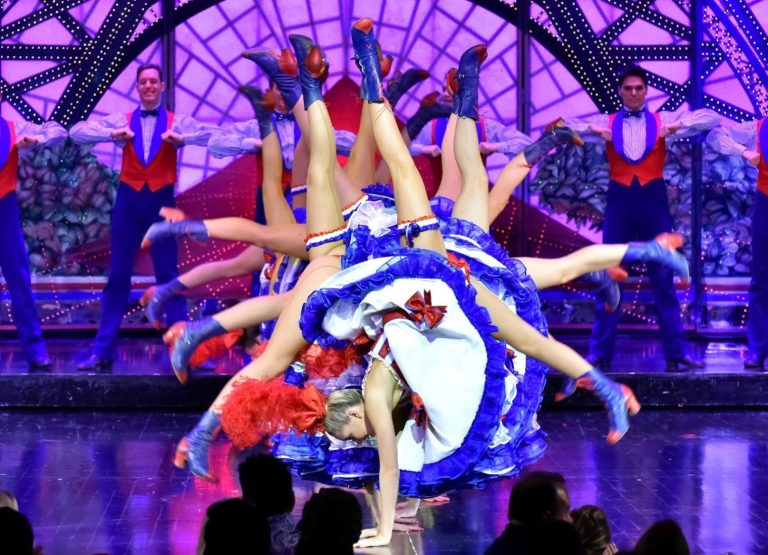
A physical and artistic performance
The French Cancan is more than a display of virtuosity. It is a full-fledged form of performance, where precision of movement, body control, and interaction with the audience create a strong stage presence. Each move, even the most acrobatic, is designed for clarity and visual impact within a fast-paced rhythm.
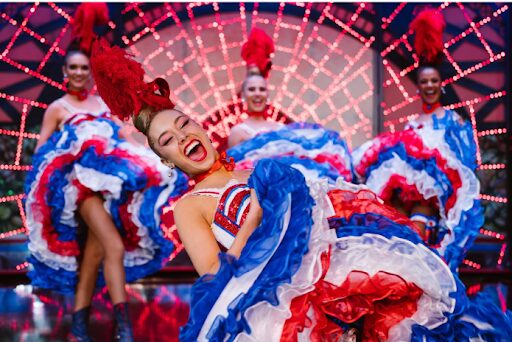
On stage, this work takes the form of a carefully orchestrated group choreography, where each dancer contributes to a larger tableau. Synchronized kicks, precise movements, confident gazes — the Cancan relies as much on the strength of the group as on the individuality of each performer. The French Cancan costume, with its colorful skirts, frills, fitted corsets, and stockings revealed in the whirl of movement, fully enhances the dance’s spectacular aesthetic, amplifying gestures and emphasizing the stage effect.
This artistic rigor is evident at the Moulin Rouge show. The stage becomes a space where physical work transforms into a clear, structured, and spectacular choreographic language, without ever losing the free-spirited and provocative essence that defines the French Cancan.
Other news
WHAT IS THE QUADRILLE AND HOW DO YOU DANCE IT?
WHAT IS THE OFFICIAL STAGE COSTUME OF THE FRENCH CANCAN?
WHAT IS THE HISTORY OF FRENCH CANCAN DANCERS?
Moulin Rouge! The Musical: Broadway’s Most Spectacular Night Out
THE BEST NEIGHBORHOODS IN PARIS TO EXPLORE: OUR SELECTION